Every form complete, before the driver stands up.
ExamFlow is software for certified medical examiners. The driver fills in their own history before they arrive, on their own phone — they photograph the back of their licence and their details fill themselves in — or on a tablet in your waiting room if they turn up without having done it. You get the Handbook rule at the moment it bears on your decision, with the citation, and an MCSA-5875 and MCSA-5876 with nothing left blank.
Your National Registry number is on every form you sign. This is software built as though that is the point.
$79 per examiner, per month. A solo examiner gets what a six-examiner group gets.
A DOT physical, start to finish
The same visit you already run, with the typing taken out of it. Nothing below is a different way of working — it is the order a driver already moves through your clinic.
1 · The driver scans their licence
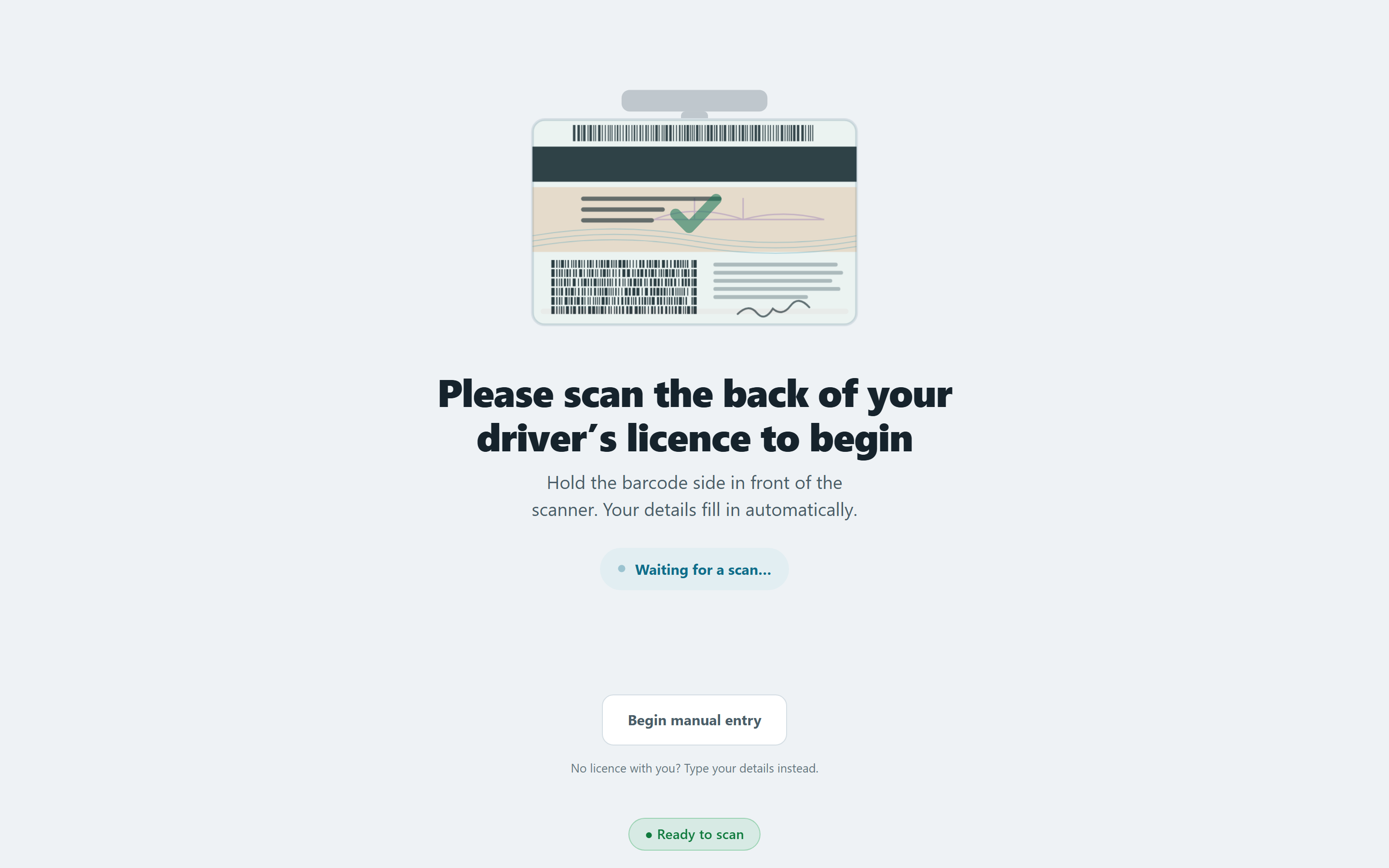
The barcode on a US licence carries the driver’s details in a standard format. What it fills in is exactly what the MCSA-5875 asks for at the top — and exactly what the National Registry is expecting, character for character.
This is the step that saves you the kickbacks. A middle initial that should not be there, a hyphen that should, a name typed the way it sounds — and the submission comes back for correction days later, with the driver long gone and the clock running. The scan removes the keystroke that causes it. A driver without their licence types it instead, and a staff member can do the whole thing at the front desk if you would rather.
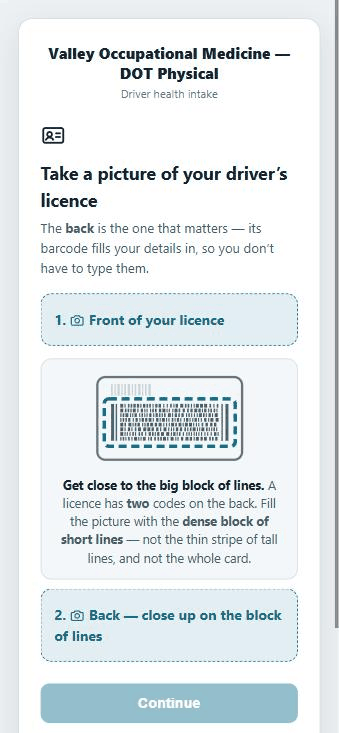
Or none of it happens in your waiting room at all. Each clinic has one permanent link. Send it to a driver when the appointment is made and they photograph their licence and answer their history at home, the night before, on the phone in their pocket. The link opens a blank form and nothing else — it cannot see your board, any chart, any other driver, or any search. A driver who ignores it still walks in and uses the tablet; a driver who used it is already done when they arrive.
2 · They answer their own history, while they wait
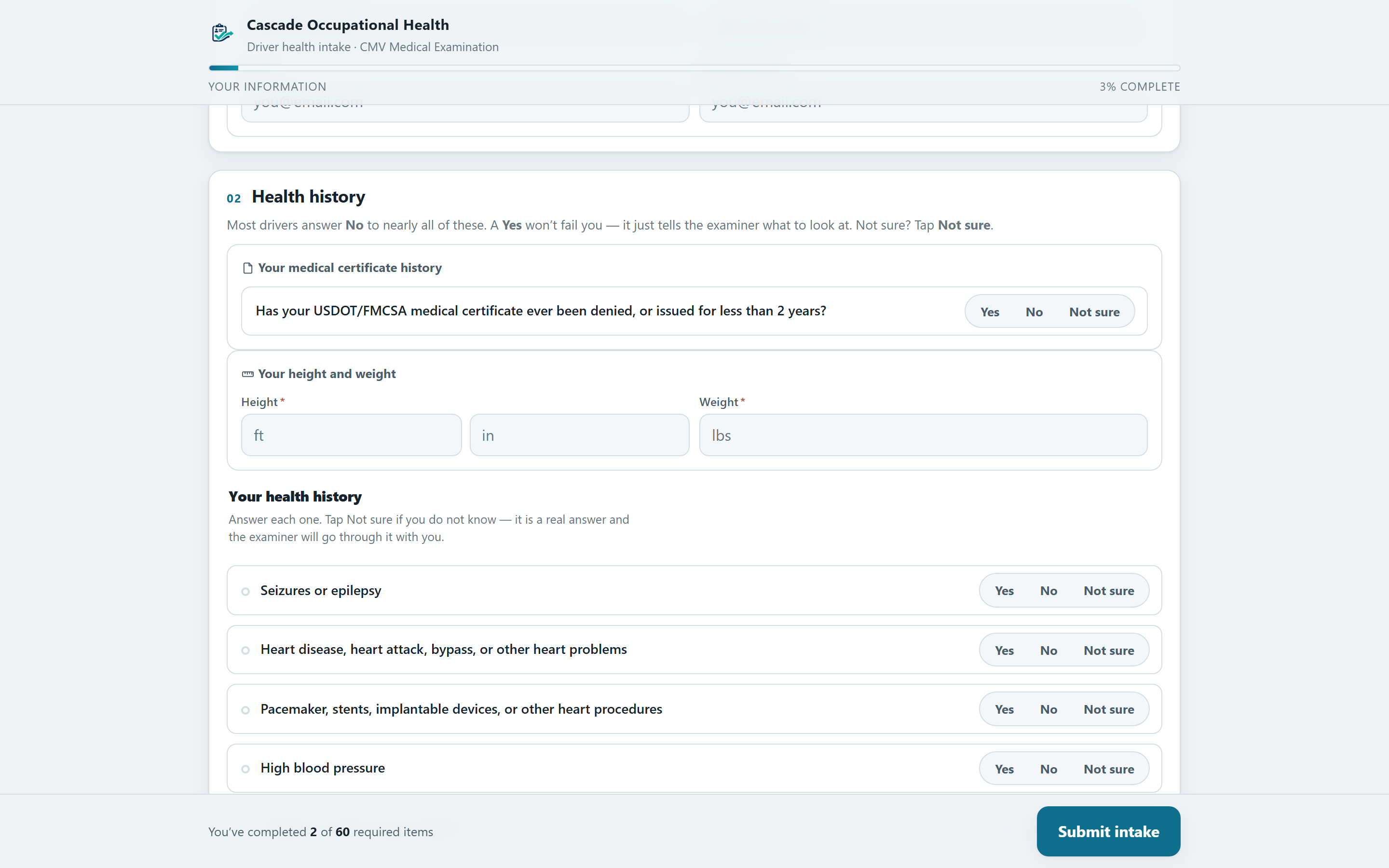
A DOT physical starts with the same thirty questions every time, and in most clinics somebody asks them out loud and types the answers. Here the driver answers them on a tablet in the waiting room, during time they would have spent waiting anyway. By the time they are called in, the examiner is reading rather than typing.
“Not sure” is a real answer
Every health question offers Yes, No and Not sure, and Not sure is recorded as itself rather than pushed into a No. A driver who does not know whether they were told something ten years ago is telling the truth, and the examiner is the right person to resolve it.
A Yes asks one more question
Answering Yes to a condition opens a box for the detail — when, what, who treats it. The examiner arrives with the follow-up already answered instead of starting it.
It saves as they go
One page, no next-next-next, and a count of what is still outstanding. A driver who puts the tablet down and picks it up again has lost nothing.
Signed, in their words
It is signed and lands on the examiner’s screen. What the driver said is what the record says, with their signature against it — worth more than a staff member’s summary of it if anybody ever asks.
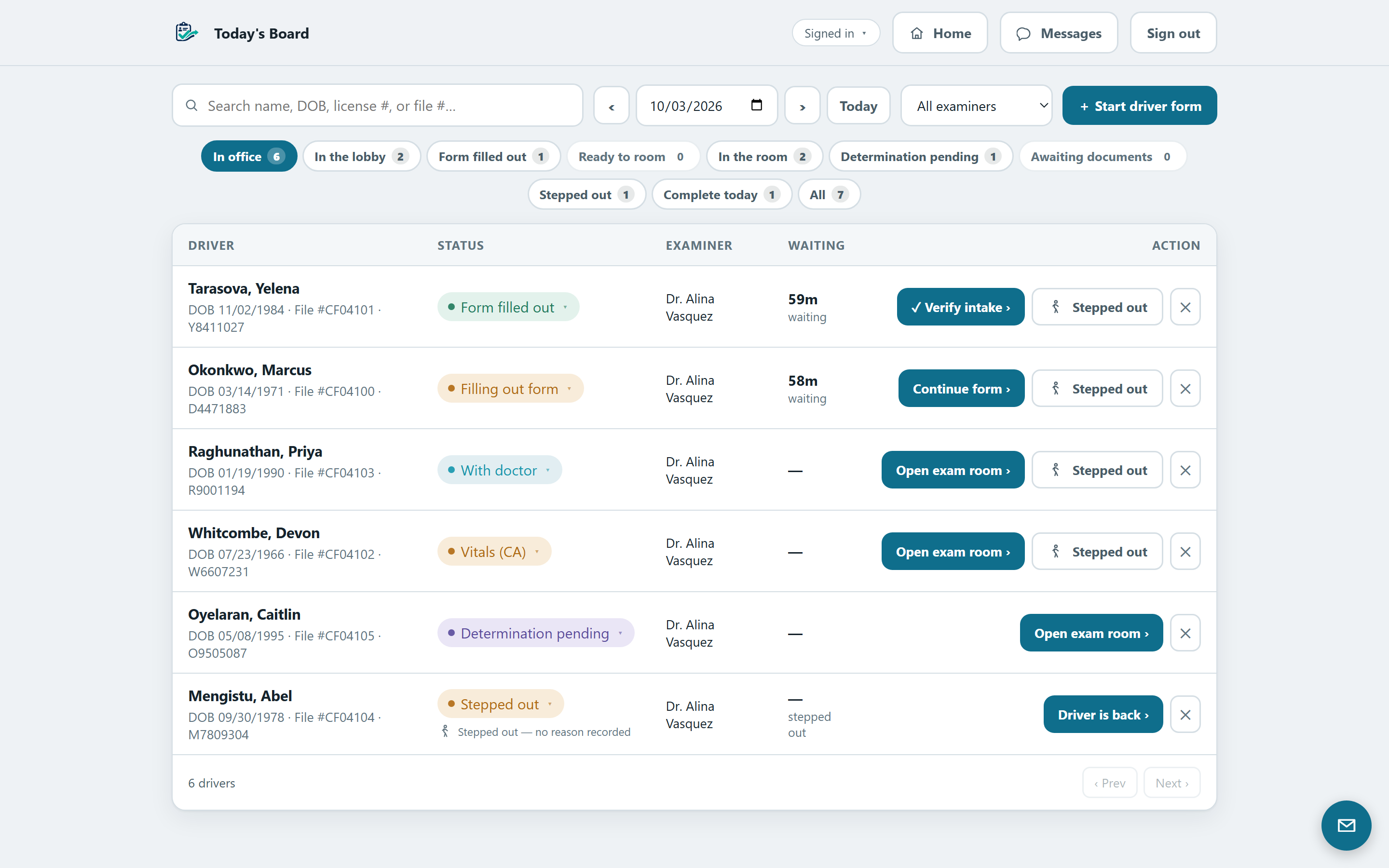
3 · Your board shows who is here and where they are
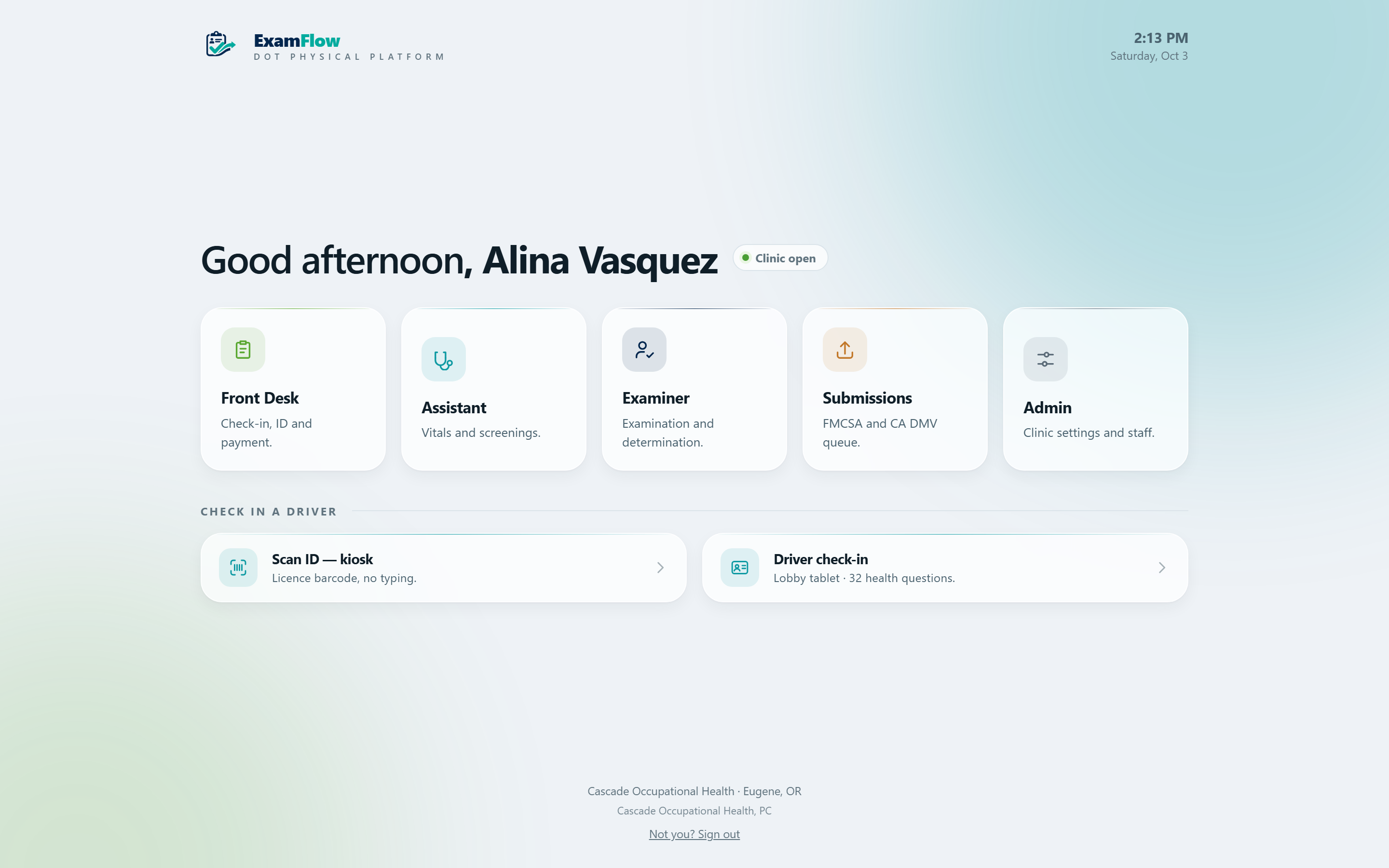
Who has arrived, who is still filling in their history, who is in with the examiner, who is waiting on a determination, and how long each of them has been there. Your assistant works the board; the examiner picks up a driver who is ready.
4 · The rule appears where the decision is made
When blood pressure, vision, hearing or a listed condition bears on the certificate, the applicable Handbook passage and CFR section are shown at the decision — not in a manual on a shelf.
Take a reading of 150/95. ExamFlow stages it, says what that stage means for the certificate, and shows you where it got that from:
150/95 — Stage 1. Certificate up to 12 months.
Medical Examiner’s Handbook §4.6 · 49 CFR
391.41(b)(6)
You are not deciding whether you remembered it correctly. You are deciding whether you agree — and where you do not, your reason goes on the record beside it. The same is true of an insulin-treated driver and whether the MCSA-5870 is dated within 45 days, of a vision field, of a hearing threshold. The passage is there, with its citation, at the moment it bears on what you are about to sign.
5 · You decide, and the forms come out complete
The MCSA-5875 and MCSA-5876 are filled and flattened from what was recorded. Missing fields are named before you print, not after — the form has well over a hundred of them, and finding the blank one with the driver still in the room is the ordinary way that goes wrong.
6 · Nothing is forgotten at filing
The typing is not the risk. Forgetting is. A certificate you signed and did not file is your exposure, under your own National Registry number, and it is usually found weeks later by somebody else. Most clinics track this on a clipboard, a spreadsheet, or in the head of whoever normally does it.
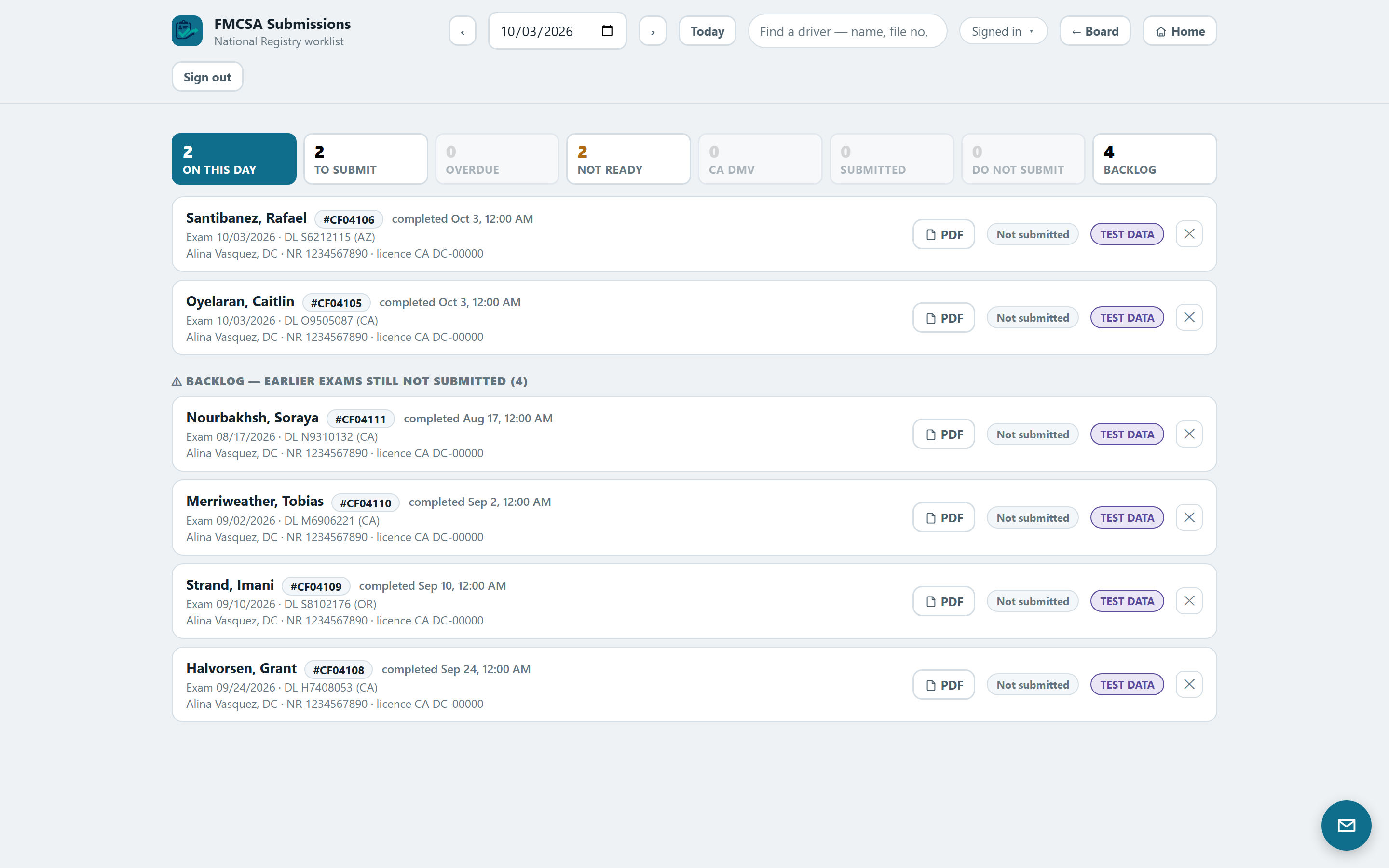
ExamFlow gives you one screen for every examination waiting to reach the National Registry, and it is the screen this software was worth building for on its own:
- To submit, overdue, and not ready yet — separated, so the ones that have fallen behind are not buried among the ones that were finished an hour ago.
- The backlog is visible. Examinations from earlier weeks that still have not been filed sit in their own count, rather than scrolling off the end of a list.
- The ones that must never be filed say so, with the reason — instead of sitting there looking unfinished and being “dealt with” by somebody who does not know why they are there.
- California’s DMV submission is tracked separately, because it is a second destination with its own deadline, not a tick on the first one.
- It cannot go stale. The state comes from the examination record itself. There is no second list to keep in step, which is the part that always rots.
You file it in the Registry as you do now, then tick it off here. The worklist is doing the remembering, and it does not forget when the person who usually does it is on holiday.
7 · And it answers questions afterwards
A record that holds up
Every change is written to an append-only audit log by the database itself — who, what, when, and the values before and after. Signing in, printing, exporting, filing and voiding are recorded too. It cannot be edited afterwards, which is the only property that makes it worth having. There is one exception, and it is written into your BAA: if you ask us to destroy your records after you leave, the before-and-after values inside the log are erased. The entries themselves remain — who did what, when, and to which record.
Certificates that expire visibly
Expiring certificates are listed thirty days ahead, so you can call the driver before the card runs out. A driver who comes back is a driver you did not have to find. Sending that reminder by text is coming as an optional add-on.
Your records, exportable
Every examination, every generated PDF and every attachment can be exported at any time, and are on cancellation. They are your records.
Three years, answerable
49 CFR 391.43(i) requires the report and the certificate for three years. A filing cabinet answers that until somebody asks which examiner decided what, and when.
What it takes out of the visit
If you do DOT exams, you know the failure modes. These are the four the flow above is shaped around.
The same details, typed three times
Name, date of birth and licence number go onto the intake form, into the chart, and onto the federal form. Each copy is a chance to transpose a digit — and a digit or a middle initial out of place is a submission the National Registry sends back. The scan at step 1 is the only time they are entered at all.
A field missed, found at the printer
The MCSA-5875 has well over a hundred fields and no software telling you which one is blank. You find out with the driver still in the room — or you find out at step 5, before you print.
A rule half-remembered
The Handbook says. It is rarely open. Step 4 puts the passage and the citation where the decision is being made instead.
Thirty questions, asked out loud
Somebody reads them to the driver and types the answers, twice over if the driver changes one. At step 2 the driver answers them, signs them, and they arrive already written.
The examiner decides. Always.
ExamFlow does not practise medicine and does not make determinations. It shows what the Handbook and 49 CFR 391.41–391.49 say, with the citation, and records what you decided.
Where guidance is advisory, it is marked advisory. You may depart from any of it, and your reason stays on the record. A certificate length the software suggests is a suggestion you can overrule, and the record shows that you did.
This is not a disclaimer bolted on afterwards. It is how the product is built, and it is why a determination made in ExamFlow is defensibly yours.
$79 per examiner, per month
One price, whatever your size. A solo examiner gets exactly what a six-examiner group gets — driver intake, today’s board, the assistant workflow, decision support with citations, the federal forms, the filing worklist, document storage, the audit log and export. No setup fee, no per-exam charge, no annual contract. Cancel whenever you like and take your records with you.
Automatic reminder texts to drivers whose cards are about to expire are coming as an optional add-on. Tell us you want them and you will hear the day they are ready.
Today, we get it ready and you file it. ExamFlow produces the completed MCSA-5875 and MCSA-5876 and keeps a live worklist of what still has to reach the National Registry, what is overdue, and what is not ready yet. You enter it there as you do now and tick it off here — the forgetting is the part we have taken out.
Filing on your behalf: not yet, and we are actively building the infrastructure for it. We intend to register with FMCSA as a Third Party Organization, and the work in progress is the platform that has to exist before that application can be made — a submission has to be auditable, attributable to the examiner who signed it, and recoverable, before anyone should be sending one on your behalf.
The day we are registered, this page will say so and give the TPO ID — and there is one step only you can take, selecting the organization in your own National Registry account. It will be an optional add-on, so a practice that would rather keep filing itself never pays for it, and the worklist above does not depend on it: tracking what has to be filed is useful whether we file it or you do. Say you want it and we will come to you the day it is live. We will not say it is coming on a date we have not been given.
For a limited time we are offering a free month. We are onboarding now and we want your arguments as much as your money. If you examine drivers regularly and you are willing to tell us what would make it better, start a trial and tell us — there is a button for it inside ExamFlow on every screen.
Security, and what we will not claim
Each clinic isolated in the database
Not by a filter in the application that somebody can forget. Isolation is enforced by the database itself, on every table, and a test fails the build if a new table is added without it.
Encrypted, and the backups too
Records are encrypted in transit and at rest. Backups are separately encrypted, and the key is held apart from them — a backup whose key sits beside it protects against very little.
Individual accounts, and an audit log
Every person has their own account; shared logins make an audit trail fiction. Two-factor authentication is available for administrators.
A Business Associate Agreement
Signed with every subscribing practice, because we hold protected health information on your behalf and that is what the rule requires.
What we do not claim. ExamFlow is not "FMCSA approved" — no software is, and any vendor telling you otherwise is describing something that does not exist. There is no such thing as HIPAA certification, so we do not say we have one; we say what we actually do, above. We do not sell your data and we do not train machine-learning models on it.
We publish a plain-language summary of where we stand on every regulation that applies, and we will send it to you before you buy anything.
Questions we get asked
- Does this replace my EMR?
- No. It does the DOT examination and the federal forms. Most practices keep their EMR for everything else.
- What happens to my records if I stop paying?
- You get a complete export — every examination, every PDF, every attachment — for sixty days after your subscription ends. After that we keep your records in a secure archive for seven years from the day your subscription ended, so if you come back, your clinic is exactly as you left it — same records, same settings, nothing to re-enter. At the end of the seven years we destroy them, and we email your administrator sixty days before we do. You can ask us to destroy them sooner at any time, and we confirm it in writing. Two things we keep even then, and the Terms say so before you subscribe: our audit log keeps its entries — who did what, when, to which record — with your record content erased from them; and any National Registry submissions we make on your behalf we keep for six years, because FMCSA holds us responsible for everything sent on our account.
- Other platforms say it is impossible to submit an incorrect exam. Why not yours?
- Because we would have to choose what "incorrect" means, and most of the time that is your call rather than ours. Where a regulation is unambiguous, ExamFlow does stop you — a certificate cannot be issued without the fields the form requires, and the examination cannot be completed without the determination. What we will not do is block a decision the regulation leaves to the examiner. Two things go wrong when software does. A driver in the room gets sent away over a judgement you were entitled to make; or you work around the software, and then the record shows a value you did not mean and no reason for it. The certificate goes to the National Registry under your own NR number, and we are not willing to be the reason it says something you did not decide. So the rule appears with its citation at the moment it matters, you may depart from it, and your reason stays on the record — which is a stronger answer to an auditor than a field that could not be typed.
- Can my assistant do the intake and vitals?
- Yes, and the workflow is built around it — including the hand-off to the examiner, and what happens when a reading is missing. If you work without an assistant, that workflow turns off and the examiner does it all.
- Do you submit to the National Registry for me?
- Not yet — today you file the result in the Registry as you do now, and ExamFlow gives you the completed form and a worklist so none is forgotten; you tick each one off as you file it. Filing on your behalf is what we are building next: we intend to register with FMCSA as a Third Party Organization, and the day we are, this page will say so and give the TPO ID. There is one step only you can take — selecting the organization in your own National Registry account.
- How much does it cost?
- $79 per examiner, per month, and a solo examiner gets exactly what a six-examiner group gets. No setup fee, no per-exam charge and no annual contract. Cancel whenever you like and take your records with you.
- Can I try it before I pay for it?
- Yes. A demonstration runs on an example clinic and takes about twenty minutes. If you examine drivers regularly we will set you up on your own clinic with free months while you tell us what is wrong with it — we are onboarding the first practices now and their arguments are worth more to us than their money.
- Does it know my state's extra requirements?
- The examination records whether a State variance was applied, and California’s DMV submission is supported. Other states’ extra requirements are not encoded yet. Tell us which state you are in and we will tell you exactly what it does today, before you buy.
- What if the internet goes down?
- Keep a paper fallback. Any hosted system can be unreachable, and a clinic with a driver in the room and no alternative has made our bad day into theirs. We would rather say that than promise otherwise.
Talk to us
A demonstration takes about twenty minutes and runs on an example clinic — no real records involved. If you examine drivers regularly, we would like to show you and hear what is missing.
Tell us roughly how many DOT exams you do a month and which state you are in, and the first reply will be useful rather than a calendar link.